
在VUE项目中,一些过渡和动画效果往往能给产品加分,能带来更好的用户体验,所以这方面的技术,我们需要熟练掌握。在本章中,我们将讨论VueJS中可用的过渡和动画功能。
过渡
当在DOM中添加/更新HTML元素时,VueJS提供了多种方法来将过渡应用于HTML元素。VueJS具有内置的过渡组件,需要将其包装在需要过渡的元素周围。
语法
<transition name = "nameoftransition">
   <div></div>
</transition>
接下来演示通过一个实例来了解下过渡的工作原理。
<html>
   <head>
    <title>VueJs过渡和动画 - Web176教程网/https://www.web176.com</title>
    <script type = "text/javascript" src = "/demo/vue/vue2.min.js"></script>
   </head>
   <body>
      <style>
         .fade-enter-active, .fade-leave-active {
            transition: opacity 2s
         }
         .fade-enter, .fade-leave-to /* .fade-leave-active below version 2.1.8 */ {
            opacity: 0
         }
      </style>
      <div id = "databinding">
         <button v-on:click = "show = !show">点击我</button>
         <transition name = "fade">
            <p v-show = "show" v-bind:style = "styleobj">欢迎来到Web176教程网</p>
         </transition>
      </div>
      <script type = "text/javascript">
         var vm = new Vue({
            el: '#databinding',
            data: {
               show:true,
               styleobj :{
                  fontSize:'30px',
                  color:'red'
               }
            },
            methods : {
            }
         });
      </script>
   </body>
</html>
上述案例解析
我们创建了一个名为clickme的按钮,使用该按钮可以将变量show的值更改为true到false,反之亦然。有一个p标签,仅在变量为true时才显示文本元素。我们用过渡元素包装了p标签,如下面的代码所示。
<transition name = "fade">
   <p v-show = "show" v-bind:style = "styleobj">Animation Example</p>
</transition>
过渡的名称是fade。VueJS提供了一些用于过渡的标准类,并且这些类的前缀是过渡的名称。
以下是一些过渡的标准类:
- v- enter-在更新/添加元素之前首先调用此类。它的起始状态。
- v-enter-active-此类用于定义进入过渡阶段的延迟,持续时间和缓动曲线。这是整个活动状态,并且在整个进入阶段都可以使用该类。
- v-leave-触发离开过渡时添加,删除。
- v-leave- active-在离开阶段应用。过渡完成后将其删除。此类用于在离开阶段应用延迟,持续时间和缓动曲线。
以上每个类都将以过渡名称作为前缀。我们将过渡的名称设置为衰落,因此类的名称变为.fade_enter,.fade_enter_active,.fade_leave,.fade_leave_active。
它们在以下代码中定义。
<style>
   .fade-enter-active, .fade-leave-active {
      transition: opacity 2s
   }
   .fade-enter, .fade-leave-to /* .fade-leave-active below version 2.1.8 */ {
      opacity: 0
   }
</style>
.fade_enter_active和.fade_leave_active一起定义,并且在开始和离开阶段应用过渡。opacity属性在2秒内更改为0。
持续时间在.fade_enter_active和.fade_leave_active中定义。最后阶段在.fade_enter,.fade_leave_to中定义。
浏览器中的显示如下:


默认是上图效果,当我们点击按钮后,下面文字会2S淡出消失,请运行上面的DEMO代码试试。
让我们考虑另一个示例,其中有一个图像,当单击按钮时,它在x轴上移动。
<html>
   <head>
    <title>VueJs过渡和动画 - Web176教程网/https://www.web176.com</title>
    <script type = "text/javascript" src = "/demo/vue/vue2.min.js"></script>
   </head>
   <body>
      <style>
         .shiftx-enter-active, .shiftx-leave-active {
            transition: all 2s ease-in-out;
         }
         .shiftx-enter, .shiftx-leave-to /* .fade-leave-active below version 2.1.8 */ {
            transform :  translateX(100px);
         }
      </style>
      <div id = "databinding">
         <button v-on:click = "show = !show">点击</button>
         <transition name = "shiftx">
            <p v-show = "show">
               <img src = "/wp-content/uploads/2020/11/vue.jpg" style = "width:100px;height:100px;" />
            </p>
         </transition>
      </div>
      <script type = "text/javascript">
         var vm = new Vue({
            el: '#databinding',
            data: {
               show:true
            },
            methods : {
            }
         });
      </script>
   </body>
</html>转换的名称为shiftx。使用下面的代码,可以使用transform属性将x轴上的图像移动100px。
<style>
   .shiftx-enter-active, .shiftx-leave-active {
      transition: all 2s ease-in-out;
   }
   .shiftx-enter, .shiftx-leave-to /* .fade-leave-active below version 2.1.8 */ {
      transform :  translateX(100px);
   }
</style>
效果:当我们点击按钮时候,图片会往右边移动。大家看看预览效果吧。
Animation – 动画
动画的应用与过渡相同。动画还具有需要声明的类才能产生效果。
让我们考虑一个示例,看看动画是如何工作的。
例
<html>
   <head>
    <title>VueJs过渡和动画 - Web176教程网/https://www.web176.com</title>
    <script type = "text/javascript" src = "/demo/vue/vue2.min.js"></script>
   </head>
   <body>
      <style>
         .shiftx-enter-active {
            animation: shift-in 2s;
         }
         .shiftx-leave-active {
            animation: shift-in 2s reverse;
         }
         @keyframes shift-in {
            0%   {transform:rotateX(0deg);}
            25%  {transform:rotateX(90deg);}
            50%  {transform:rotateX(120deg);}
            75%  {transform:rotateX(180deg);}
            100% {transform:rotateX(360deg);}
         }
      </style>
      <div id = "databinding">
         <button v-on:click = "show = !show">点击</button>
         <transition name = "shiftx">
            <p v-show = "show">
               <img src = "/wp-content/uploads/2020/11/vue.jpg" style = "width:100px;height:100px;" />
            </p>
         </transition>
      </div>
      <script type = "text/javascript">
         var vm = new Vue({
            el: '#databinding',
            data: {
               show:true
            },
            methods : {
            }
         });
      </script>
   </body>
</html>
要应用动画,有与过渡相同的类。在上面的代码中,我们将图像封装在p标记中,如以下代码所示。
<transition name = "shiftx">
   <p v-show = "show"><img src = "images/img.jpg" style = "width:100px;height:100px;" /></p>
</transition>
转换的名称为shiftx。应用的类如下-
<style>
   .shiftx-enter-active {
      animation: shift-in 2s;
   }
   .shiftx-leave-active {
      animation: shift-in 2s reverse;
   }
   @keyframes shift-in {
      0%   {transform:rotateX(0deg);}
      25%  {transform:rotateX(90deg);}
      50%  {transform:rotateX(120deg);}
      75%  {transform:rotateX(180deg);}
      100% {transform:rotateX(360deg);}
   }
</style>
该类的前缀为过渡名称,即shiftx-enter-active和.shiftx-leave-active。动画的关键帧定义为0%到100%。在每个关键帧处定义了一个转换,如以下代码所示。
@keyframes shift-in {
   0%   {transform:rotateX(0deg);}
   25%  {transform:rotateX(90deg);}
   50%  {transform:rotateX(120deg);}
   75%  {transform:rotateX(180deg);}
   100% {transform:rotateX(360deg);}
}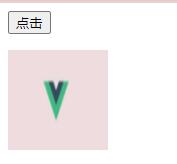
点击按钮后,图片有翻转动画效果。试试吧!
自定义过渡类(Custom Transition Classes)
VueJS提供了一系列自定义类,可以将它们作为属性添加到过渡元素中。
- enter-class
- enter-active-class
- leave-class
- leave-active-class
当我们要使用外部CSS库(例如animate.css)时,自定义类基本上可以发挥作用。
例
<html>
   <head>
    <title>VueJs自定义动画 - Web176教程网/https://www.web176.com</title>
    <script type = "text/javascript" src = "/demo/vue/vue2.min.js"></script>
      <link href = "https://cdn.jsdelivr.net/npm/animate.css@3.5.1" rel = "stylesheet" type = "text/css">
   </head>
   <body>
      <div id = "animate" style = "text-align:center">
         <button @click = "show = !show"><span style = "font-size:25px;">Animate</span></button>
         <transition
            name = "custom-classes-transition"
            enter-active-class = "animated swing"
            leave-active-class = "animated bounceIn">
            <p v-if = "show"><span style = "font-size:25px;">Web176教程网</span></p>
         </transition>
      </div>
      <script type = "text/javascript">
         var vm =  new Vue({
            el: '#animate',
            data: {
               show: true
            }
         });
      </script>
   </body>
</html>
运行看下效果。
上面的代码中应用了两个动画。一个enter-active-class =“动画挥杆”,另一个leave-active-class =“动画bounceIn”。我们正在将自定义动画类用于要从第三方库中应用的动画。
显式过渡持续时间(Explicit Transition Duration)
我们可以使用VueJS在元素上应用过渡和动画。Vue等待transionend和animationend事件检测动画或过渡是否完成。
有时过渡可能会导致延迟。在这种情况下,我们可以如下明确地应用持续时间。
<transition :duration = "1000"></transition>
<transition :duration = "{ enter: 500, leave: 800 }">...</transition>
我们可以将duration属性与过渡元素上的:一起使用,如上所示。如果需要分别指定进入和离开的持续时间,可以按照上面的代码所示进行。
JavaScript挂钩
可以将过渡类称为使用JavaScript事件的方法。让我们考虑一个更好理解的例子。
例
<html>
   <head>
    <title>VueJs动画 - Web176教程网www.web176.com</title>
    <script type = "text/javascript" src = "/demo/vue/vue2.min.js"></script>
   </head>
   <body>
      <script src = "https://cdnjs.cloudflare.com/ajax/libs/velocity/1.2.3/velocity.min.js"></script>
      <div id = "example-4">
         <button @click = "show = !show">
            <span style = "font-size:25px;">Toggle</span>
         </button>
         <transition  v-on:before-enter = "beforeEnter"
            v-on:enter = "enter"
            v-on:leave = "leave"
            v-bind:css = "false">
            <p v-if = "show" style = "font-size:25px;">Web176教程网www.web176.com</p>
         </transition>
      </div>
      <script type = "text/javascript">
         var vm = new Vue({
            el: '#example-4',
            data: {
               show: false
            },
            methods: {
               beforeEnter: function (el) {
                  el.style.opacity = 0
               },
               enter: function (el, done) {
                  Velocity(el, { opacity: 1, fontSize: '25px' }, { duration: 1000 })
                  Velocity(el, { fontSize: '10px' }, { complete: done })
               },
               leave: function (el, done) {
                  Velocity(el, { translateX: '15px', rotateZ: '50deg' }, { duration: 1500 })
                  Velocity(el, { rotateZ: '100deg' }, { loop: 2 })
                  Velocity(el, {
                     rotateZ: '45deg',
                     translateY: '30px',
                     translateX: '30px',
                     opacity: 0
                  }, { complete: done })
               }
            }
         });
      </script>
   </body>
</html>
在上面的示例中,我们在过渡元素上使用js方法执行动画。
过渡方法适用如下:
<transition  v-on:before-enter = "beforeEnter"
   v-on:enter = "enter"
   v-on:leave = "leave"
   v-bind:css = "false">
   <p v-if = "show" style = "font-size:25px;">Animation Example with velocity</p>
</transition>
在v-on上添加了一个前缀,以及调用该方法的事件的名称。这些方法在Vue实例中定义如下:
methods: {
   beforeEnter: function (el) {
      el.style.opacity = 0
   },
   enter: function (el, done) {
      Velocity(el, { opacity: 1, fontSize: '25px' }, { duration: 1000 })
      Velocity(el, { fontSize: '10px' }, { complete: done })
   },
   leave: function (el, done) {
      Velocity(el, { translateX: '15px', rotateZ: '50deg' }, { duration: 1500 })
      Velocity(el, { rotateZ: '100deg' }, { loop: 2 })
      Velocity(el, {
         rotateZ: '45deg',
         translateY: '30px',
         translateX: '30px',
         opacity: 0
      }, { complete: done })
   }
}
这些方法中的每一种都将应用所需的转换。单击按钮时以及完成动画后,都会应用不透明度动画。第三方库用于动画。
在过渡v-bind:css =“ false”上添加了一个属性,这样做是为了使Vue理解这是一个JavaScript过渡。
初始渲染时的过渡
为了在开始时添加动画,我们需要在过渡元素中添加“ appear”属性。
让我们看一个例子,以更好地理解它。
例
<html>
   <head>
    <title>VueJs - Web176教程网/https://www.web176.com</title>
    <script type = "text/javascript" src = "/demo/vue/vue2.min.js"></script>
      <link href = "https://cdn.jsdelivr.net/npm/animate.css@3.5.1" rel = "stylesheet" type = "text/css">
   </head>
   <body>
      <div id = "animate" style = "text-align:center">
         <transition
            appear
            appear-class = "custom-appear-class"
            appear-active-class = "animated bounceIn">
            <h1>BounceIn - Animation Example</h1>
         </transition>
         <transition
            appear
            appear-class = "custom-appear-class"
            appear-active-class = "animated swing">
            <h1>Swing - Animation Example</h1>
         </transition>
         <transition
            appear
            appear-class = "custom-appear-class"
            appear-active-class = "animated rubberBand">
            <h1>RubberBand - Animation Example</h1>
         </transition>
      </div>
      <script type = "text/javascript">
         var vm =  new Vue({
            el: '#animate',
            data: {
               show: true
            }
         });
      </script>
   </body>
</html>
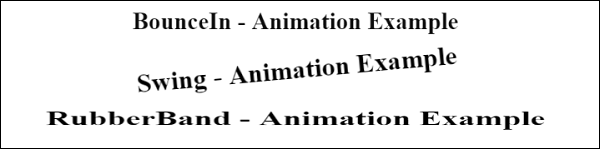
在上面的示例中,我们使用了animate.css库中的三种不同的动画。我们在过渡元素中添加了外观。
执行上述代码后,浏览器将输出以下内容。
组件动画
我们可以使用以下代码包装组件的过渡。我们在这里使用了动态组件。
例
<html>
   <head>
    <title>VueJs - Web176教程网/https://www.web176.com</title>
    <script type = "text/javascript" src = "/demo/vue/vue2.min.js"></script>
      <link href = "https://cdn.jsdelivr.net/npm/animate.css@3.5.1" rel = "stylesheet" type = "text/css">
   </head>
   <body>
      <div id = "databinding" style = "text-align:center;">
         <transition  appear
            appear-class = "custom-appear-class"
            appear-active-class = "animated wobble">
            <component v-bind:is = "view"></component>
         </transition>
      </div>
      <script type = "text/javascript">
         var vm = new Vue({
            el: '#databinding',
            data: {
               view: 'component1'
            },
            components: {
               'component1': {
                  template: '<div><span style = "font-size:25;color:red;">Animation on Components</span></div>'
               }
            }
         });
      </script>
   </body>
</html>
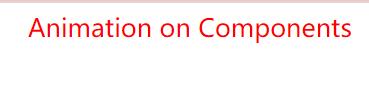
效果预览看下:
OK,关于VueJS中可用的过渡和动画功能,就讲这么多。
作者:terry,如若转载,请注明出处:https://www.web176.com/vuejs/1008.html
 支付宝
支付宝  微信
微信 